Finding a good graphics card for gaming in 2026 can feel like navigating a tech maze. With busy lives balancing work, family, and personal time, gamers often struggle to keep up with the latest hardware trends, budget-friendly options, and performance demands of new titles. This isn't just about raw power; it's about smart choices that deliver maximum fun and value without breaking the bank or requiring a deep dive into tech specs. Our guide cuts through the hype, offering practical advice to help you select a GPU that perfectly fits your gaming style, budget, and life. Whether you're aiming for crisp 1440p adventures, smooth 1080p esports action, or dabbling in VR, we'll help you understand what truly makes a good graphics card for gaming and how to avoid common pitfalls. Get ready to optimize your play, socialize better in your favorite games, and enjoy every precious minute of your gaming escape.
Q: What is the most important factor when choosing a good graphics card for gaming?
A: The most important factor for a good graphics card for gaming is balancing performance with your target resolution and budget. For instance, a card that delivers stable 60+ frames per second at 1440p with high settings for $500 might be "better" for many gamers than a 4K capable card costing $1200 if your budget is tighter and you game on a QHD monitor. Prioritize the experience you want to have over raw power you might not utilize.
Q: How much VRAM do I actually need for gaming in 2026?
A: For 1080p gaming in 2026, 8GB of VRAM (Video Random Access Memory) is generally sufficient for most titles on high settings. If you’re playing at 1440p, 12GB is strongly recommended to ensure smooth performance and accommodate future game requirements. For demanding 4K gaming, 16GB or more is ideal. Running out of VRAM can lead to significant stuttering and texture pop-in, regardless of a card's raw processing power.
Q: Which graphics card series offers the best value for 1440p gaming right now?
A: For 1440p gaming in 2026, the NVIDIA RTX 4070/4070 SUPER and AMD RX 7800 XT/7900 XT series often represent the best value. These cards strike an excellent balance between cost and performance, delivering smooth frame rates in most AAA titles at high settings, with good support for features like AI upscaling (DLSS or FSR) that further enhance the experience. The Intel Arc A770 can also be a surprising budget contender for certain 1440p scenarios.
Q: How do I ensure my new graphics card is compatible with my existing PC?
A: To ensure compatibility, first check your PC's power supply unit (PSU) to confirm it has enough wattage and the correct PCIe power connectors (6-pin, 8-pin, or 12VHPWR). Second, measure your PC case to ensure the graphics card physically fits, accounting for length, height, and thickness. Third, ensure your motherboard has an available PCIe x16 slot, which almost all modern motherboards do. Finally, verify your CPU isn't so old that it creates a severe bottleneck, wasting your GPU's potential.
Q: Are older generation graphics cards still good for gaming on a budget?
A: Yes, absolutely! Older generation graphics cards, like the NVIDIA RTX 30-series or AMD RX 6000-series, can still provide a good graphics card for gaming experience, especially if you're targeting 1080p or even entry-level 1440p. They often offer excellent value when found on sale or in the reputable second-hand market. Just ensure they have sufficient VRAM (8GB+) and that drivers are still actively supported for optimal performance and security updates.
Q: What role does AI upscaling (DLSS, FSR, XeSS) play in choosing a new GPU?
A: AI upscaling technologies like NVIDIA's DLSS, AMD's FSR, and Intel's XeSS are increasingly crucial for a good graphics card for gaming. They allow your GPU to render games at a lower internal resolution and then intelligently upscale them to your monitor's native resolution, resulting in significantly higher frame rates with minimal perceived loss in image quality. For many gamers, these features are game-changers, making higher resolutions or ray tracing more accessible on mid-range hardware and extending the lifespan of your GPU investment.
Q: Why should I care about my graphics card's cooling system?
A: A graphics card's cooling system is vital for maintaining optimal performance and longevity. Efficient cooling prevents thermal throttling, where the GPU automatically reduces its speed to prevent overheating, leading to reduced frame rates and stuttering. A good cooler also means quieter operation, which is a major plus for immersive gaming. Look for cards with large heatsinks, multiple fans, and good airflow to ensure your investment stays cool under pressure and performs consistently during long gaming sessions.
Hey fellow gamers! If you're anything like the average US gamer – around 36 years old, balancing a career, family, and life – you know those precious hours you carve out for gaming are sacred. You want to unwind, connect with friends in Discord, maybe chase a few skill-based achievements, or just get lost in a new world. But there’s a persistent pain point: that nagging feeling that your current rig might be holding you back. Or, if you’re looking to upgrade, the sheer overwhelm of choosing a good graphics card for gaming that delivers value without demanding hours of research.
You’re not alone. Recent US gaming statistics show 87% of gamers play regularly, often clocking 10+ hours a week, with a significant trend towards mobile gaming alongside PC and console. Yet, for many, PC remains the ultimate platform for immersive experiences. The challenge isn't just finding any graphics card; it's finding a good graphics card for gaming – one that fits your budget, handles the latest titles, and doesn't become obsolete next month. You want smooth frame rates, stunning visuals, and reliable performance without needing a degree in computer engineering. This guide is built for you. We’re here to demystify the GPU market, help you avoid setup headaches, solve performance woes, and ensure your hard-earned cash translates into maximum fun. Let’s dive in and get you back to what truly matters: gaming.
What Defines a "Good" Graphics Card for Gaming in 2026?
In 2026, a truly good graphics card for gaming isn't just about raw power; it's about intelligent performance that aligns with your specific needs. It needs to handle the most popular titles – from demanding AAA blockbusters like Cyberpunk 2077’s latest expansion or the new Elder Scrolls, to competitive esports games like Valorant or Apex Legends, and even cozy social experiences like Palia – all at your desired resolution and frame rate. Key indicators include adequate VRAM (typically 8GB-16GB for modern 1080p/1440p gaming), efficient power consumption, robust driver support, and features like ray tracing and AI upscaling (DLSS, FSR, XeSS) that enhance visuals and performance.
Consider the resolution you play at. For 1080p gaming, a mid-range card might be perfect, offering high refresh rates for competitive play. If you're aiming for stunning 1440p visuals, a higher-tier card becomes essential. For those with 4K monitors, only the top-tier GPUs will deliver a consistently smooth experience. Longevity is also crucial for busy gamers; a card that stays relevant for 3-4 years without major upgrades represents excellent value, letting you focus on life rather than constant hardware cycles.
How Much Should I Budget for a Gaming Graphics Card in 2026?
Your budget for a good graphics card for gaming largely depends on your desired performance and resolution. As of this month, the market offers great value across different tiers. Expect to spend anywhere from $300 for solid 1080p performance to $800+ for high-refresh 1440p or entry-level 4K gaming, and upwards of $1200 for premium 4K experiences.
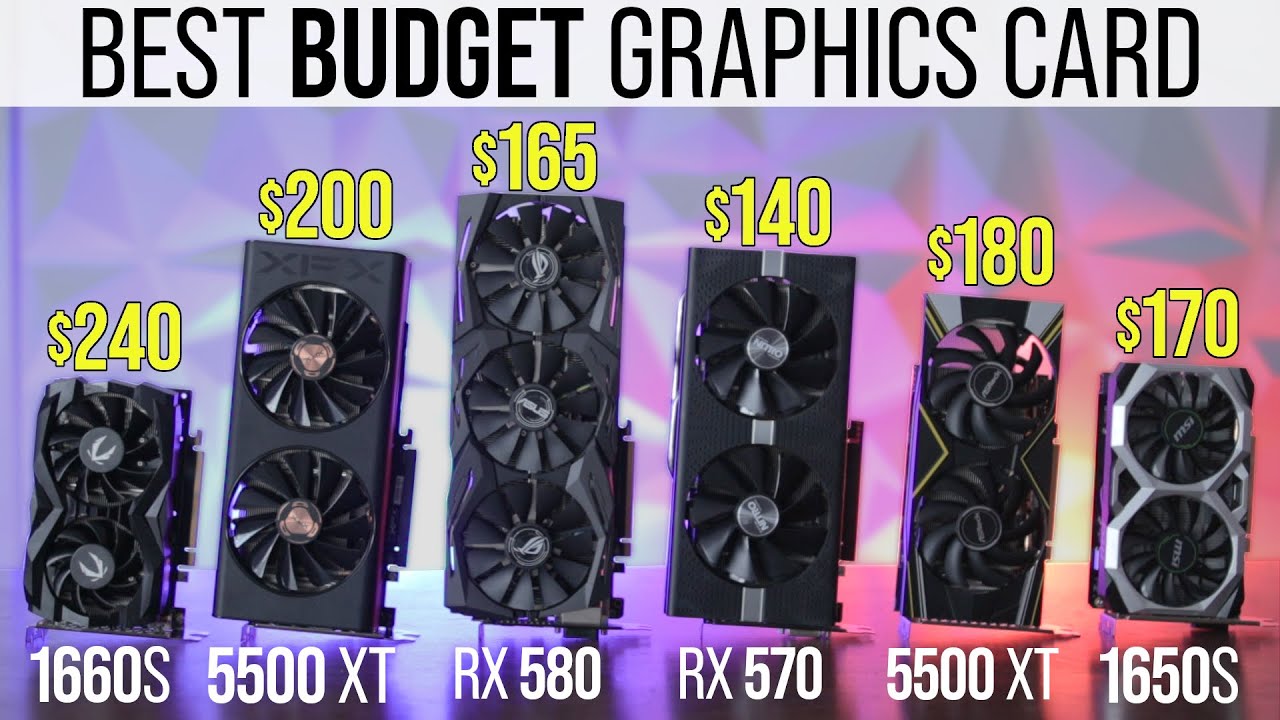
- Entry-Level ($200-$400): Perfect for 1080p gaming at high settings, achieving 60+ FPS in most titles. Great for esports and popular free-to-play games like Fortnite. Think NVIDIA RTX 3050/4060 or AMD RX 6600/7600 equivalent.
- Mid-Range ($400-$800): The sweet spot for 1440p gaming at high settings, delivering excellent frame rates. It also provides a strong foundation for some ray tracing and VR experiences. Look at NVIDIA RTX 4060 Ti/4070 or AMD RX 7700 XT/7800 XT.
- High-End ($800-$1200+): For uncompromising 1440p performance, high refresh rates, and smooth 4K gaming with ray tracing enabled. These cards are built for enthusiasts and those who want to "future-proof" their setup for several years. Examples include NVIDIA RTX 4070 Ti SUPER/4080 SUPER or AMD RX 7900 XT/7900 XTX.
Remember, value isn't just the sticker price; it's the performance per dollar and how long the card serves your gaming needs. Sometimes a slightly higher upfront investment means longer satisfaction.
Which Graphics Card Brands Offer the Best Value in 2026?
In 2026, the graphics card market is primarily dominated by NVIDIA and AMD, with Intel's Arc series making notable strides, especially in the budget and mid-range segments. Each offers unique strengths for a good graphics card for gaming.
- NVIDIA GeForce RTX: Renowned for its leading ray tracing performance and DLSS (Deep Learning Super Sampling) technology. DLSS uses AI to upscale lower-resolution images, delivering near-native image quality with significant FPS boosts, which is a game-changer for demanding titles. NVIDIA also boasts strong content creation and streaming capabilities with NVENC encoders.
- AMD Radeon RX: Often provides excellent raw rasterization performance per dollar, making them very competitive, especially in the mid to high-end. AMD's FSR (FidelityFX Super Resolution) is an open-source upscaling technology supported by a wider range of GPUs, including older cards and competitor hardware. They also excel in power efficiency with their RDNA 3 architecture.
- Intel Arc: A strong contender in the entry-level to mid-range. Intel Arc GPUs offer compelling performance for their price, particularly with XeSS (Xe Super Sampling) – their own AI upscaling tech. They also feature excellent media encoding capabilities, making them attractive for creators and streamers on a tighter budget. Driver maturity has improved significantly, making them a viable option.
Ultimately, the "best" brand depends on your specific priorities: top-tier ray tracing and AI upscaling favors NVIDIA, raw rasterization value often leans AMD, and budget-friendly with strong media features can be Intel Arc.
Can I Still Get a Good Graphics Card for Gaming on a Strict Budget?
Absolutely! For the busy gamer, a strict budget doesn't mean sacrificing fun. While premium cards are enticing, excellent 1080p and even some 1440p experiences are achievable without breaking the bank. The trick is to be smart and look for value. Focus on cards that offer strong performance in popular titles, particularly esports and free-to-play games where high frame rates are more critical than ultra-settings.
Consider last-generation cards (e.g., NVIDIA RTX 30-series or AMD RX 6000-series) on clearance or in the reputable second-hand market. With careful research and trusted sellers, you can often find fantastic deals. Intel Arc cards are also a great option for new, budget-friendly GPUs with modern features. Prioritize VRAM (8GB is a solid minimum for 1080p today) and look for strong driver support. A good CPU and sufficient RAM (16GB is standard) will also ensure your budget GPU performs its best, preventing bottlenecks that waste your investment.
How Do I Know If My Current Graphics Card Is Holding My Gaming Back?
Recognizing when your GPU is the bottleneck is key to smart upgrades. Common signs include:
- Low Frame Rates: If your games consistently run below 60 FPS (or your monitor's refresh rate) even on medium settings, your GPU might be struggling.
- Inconsistent Performance: Sudden drops in frame rates during intense action or busy scenes, known as stuttering, often point to a GPU being overwhelmed.
- Graphics Settings Limitations: Unable to enjoy higher texture settings, anti-aliasing, or advanced graphical features without a significant performance hit.
- Overheating: Your GPU fans constantly spinning at maximum, or monitoring software showing high temperatures, can indicate it's working too hard for current demands.
- Outdated Technology: If your card lacks modern features like hardware-accelerated ray tracing, DLSS/FSR support, or sufficient VRAM for today's textures, it's probably time for an upgrade.
Tools like MSI Afterburner or the in-game overlay from NVIDIA GeForce Experience or AMD Adrenalin Software can monitor GPU utilization and frame rates in real-time, giving you concrete data on its performance. If your GPU usage consistently hits 99-100% while your CPU usage is low, your graphics card is likely the bottleneck.
What Resolution and Refresh Rate Should I Target with a New GPU?
Choosing your target resolution and refresh rate is one of the most important decisions when selecting a good graphics card for gaming, as it dictates the required GPU power. Gamers balancing life and play want clarity on this, not just hype. Recent trends show 1440p gaining immense popularity among US gamers, offering a fantastic balance between visual fidelity and performance.
- 1080p (Full HD): Still incredibly popular, especially for esports titles where high frame rates (144Hz+) are crucial for competitive advantage. A mid-range GPU can easily push 100+ FPS in most games at 1080p. Perfect for budget-conscious gamers or those prioritizing buttery-smooth competitive play.
- 1440p (QHD): The sweet spot for many gamers today. It offers a significant visual upgrade over 1080p without the extreme hardware demands of 4K. A good upper-mid-range or high-end GPU can deliver 60-100+ FPS in AAA titles at 1440p, allowing for both stunning visuals and smooth gameplay. This resolution pairs well with 144Hz or 165Hz monitors.
- 4K (UHD): The pinnacle of visual fidelity, but demands top-tier, often premium-priced GPUs to achieve playable frame rates (60+ FPS) in demanding games. If you have a large 4K monitor and want the absolute best visuals, this is your target, but be prepared for a significant investment in your graphics card. Frame generation technologies like DLSS 3 or FSR 3 become almost essential here.
Align your GPU choice with your monitor's capabilities. There's little point in a powerful 4K GPU if you only have a 1080p monitor, and vice-versa.
Will Upgrading Just My Graphics Card Improve Performance if I Have an Older CPU?
This is a common question among gamers looking for a targeted upgrade. While a new, powerful graphics card can dramatically boost frame rates, an older or slower CPU (processor) can create a "bottleneck." This means your CPU can't feed data to the GPU fast enough, preventing the graphics card from performing at its full potential. Imagine a super-fast highway (your GPU) leading to a tiny, congested road (your CPU) – traffic will slow down regardless of how fast the highway is.
However, the impact of a CPU bottleneck varies. In graphically demanding games, the GPU usually does most of the heavy lifting, so an upgrade will still yield significant improvements. In CPU-intensive games (strategy games, open-world titles with many NPCs, high-refresh-rate esports), the CPU's limitations become more apparent. Before upgrading, do a quick check: monitor your CPU and GPU usage during gaming. If your GPU usage hovers below 90% while your CPU is consistently at 90-100%, you might have a significant CPU bottleneck. For an optimal experience, aim for a balanced system where neither component severely restricts the other. Sometimes, a generational leap in GPU power can compensate for a slightly older CPU, but there's a limit.
How Do Current Gaming Trends Influence My Choice of Graphics Card?
Gaming in 2026 isn't just about single-player narratives; it's a diverse ecosystem shaped by global trends and US gamer preferences. Your choice of a good graphics card for gaming should reflect this dynamic landscape:
- AI Upscaling (DLSS, FSR, XeSS): These technologies are vital. They allow GPUs to render games at a lower internal resolution and then use AI to upscale them to your monitor's native resolution, often with better-than-native image quality and a massive performance boost. A card with strong AI upscaling support (like NVIDIA's DLSS 3 with Frame Generation) can make a mid-range card feel like a high-end one, especially at 1440p or 4K. This is a huge win for value-conscious gamers.
- Social & Cozy Games: With the rise of social gaming (like Palia or Among Us) and cozy games (Stardew Valley, Animal Crossing-likes), not every gamer needs a beastly GPU. Many popular social titles are less graphically demanding, allowing more budget-friendly cards to shine. However, if you plan to stream these experiences, a GPU with dedicated encoders (NVENC or AMD's encoders) is beneficial.
- Free-to-Play (F2P) & Esports: F2P games dominate playtime for many, and esports continues to grow. These games are optimized for a wide range of hardware, meaning even a good entry-level or mid-range graphics card can deliver high refresh rates and a competitive edge. Focus on stable drivers and high FPS over ultra settings.
- VR Experiments & Cloud Gaming: While VR is still somewhat niche, it demands significant GPU power. If VR is on your horizon, aim for an upper-mid to high-end card. Cloud gaming, on the other hand, largely bypasses local GPU power, but a good local GPU ensures a smooth desktop experience outside the cloud, and for local competitive play.
These trends mean you can tailor your GPU choice to your actual gaming habits, rather than just buying the "most powerful" card.
CONCLUSION:
Choosing a good graphics card for gaming in 2026 doesn't have to be a headache. By understanding your budget, desired resolution, gaming habits, and the latest tech trends like AI upscaling, you can make an informed decision that truly enhances your precious gaming time. Remember, it’s about finding the right balance of performance, features, and value for your life. A smart GPU upgrade means less frustration and more immersion, fun, and connection with your gaming community. Go forth, upgrade smart, and enjoy your games!
What's your biggest gaming challenge? Comment below!
FAQ Section
Q: Is Ray Tracing essential for a good graphics card for gaming?
A: While visually stunning, ray tracing is still very demanding. It's not strictly "essential" for a good gaming experience, but if you want the absolute best visuals and have a higher budget, a card with strong ray tracing performance (NVIDIA often leads here) is a plus. AI upscaling often helps mitigate its performance cost.
Q: How often should I upgrade my graphics card?
A: For most gamers, upgrading every 3-4 years strikes a good balance between performance gains and cost. This allows you to experience significant generational improvements without constantly chasing the latest tech, which is perfect for busy schedules. If you're on a tighter budget, extending this to 5+ years is also feasible with smart settings adjustments.
Q: Is more VRAM always better for a gaming GPU?
A: More VRAM is generally better, especially for higher resolutions (1440p and 4K) and future-proofing. For 1080p gaming in 2026, 8GB is a solid minimum. For 1440p, 12GB is recommended, and for 4K, 16GB or more is ideal. Running out of VRAM causes severe stuttering, so having enough is crucial, but excessive VRAM on a lower-tier GPU won't magically make it faster.
Q: What is a "bottleneck" and how do I avoid it?
A: A bottleneck occurs when one component (e.g., CPU, RAM, or even storage) limits the performance of another (usually the GPU). To avoid it, aim for a balanced system where components are roughly in the same performance tier. Monitoring tools can help identify bottlenecks. If upgrading, consider your entire system, not just the GPU in isolation.
Q: Can I use a graphics card from a different brand than my CPU (e.g., AMD CPU with NVIDIA GPU)?
A: Yes, absolutely! You can freely mix and match CPU and GPU brands. An AMD Ryzen CPU works perfectly with an NVIDIA GeForce graphics card, and an Intel Core CPU works great with an AMD Radeon card. There are no compatibility issues in this regard, and it gives you the flexibility to choose the best performing component for your budget from either manufacturer.
Q: Are integrated graphics good enough for gaming in 2026?
A: For light gaming, older titles, or less graphically demanding esports and social games at 1080p, modern integrated graphics (like those found in AMD's Ryzen APUs or Intel's latest Core processors) can offer a surprisingly decent experience. However, for serious gaming, especially AAA titles at higher resolutions or refresh rates, a dedicated graphics card is still essential. They simply don't offer the power or dedicated VRAM of a discrete GPU.
High performance for modern games without overspending, understanding future-proofing for longer relevance, balancing budget with desired gaming experience, improving social and competitive play, tips for balancing gaming with daily responsibilities, identifying key specs for value, and staying updated on 2026 GPU trends.
35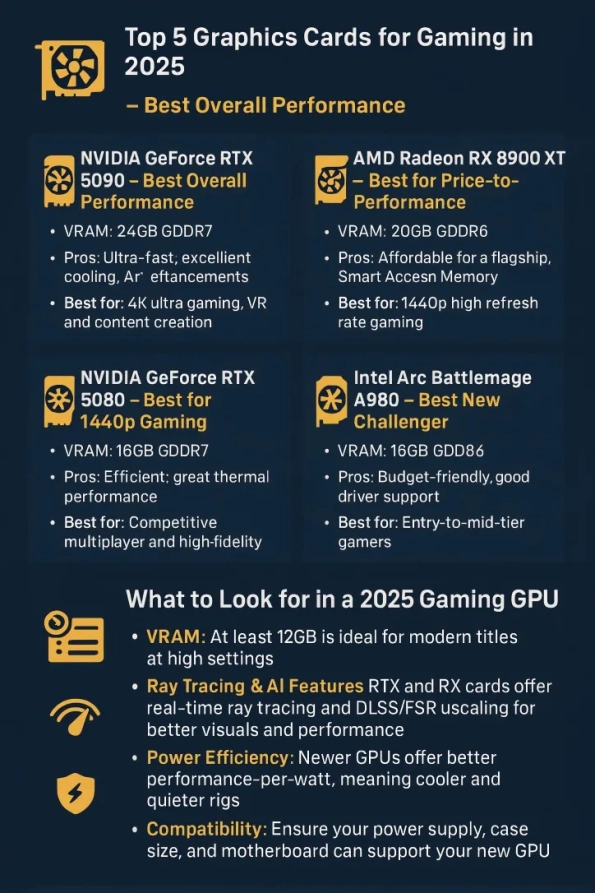
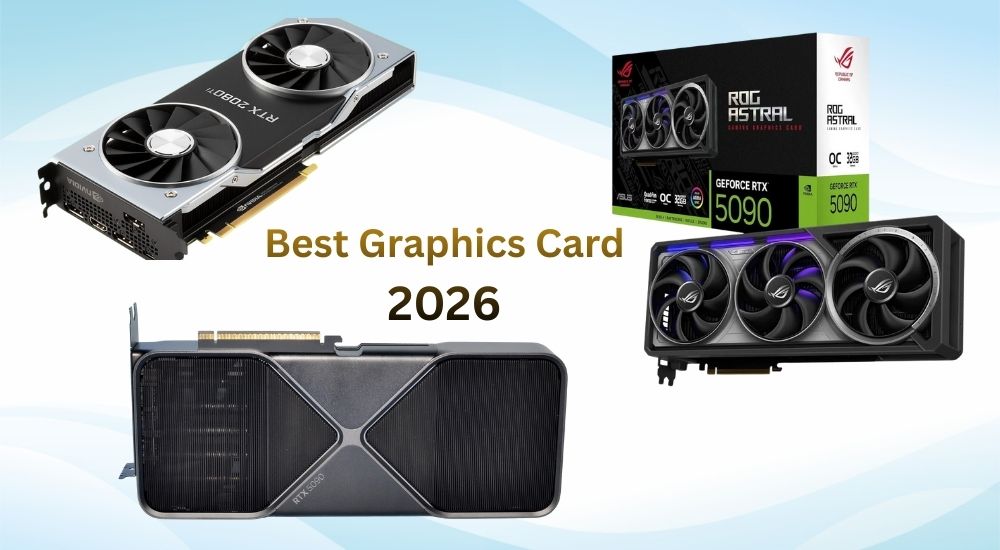


Best Graphics Cards 2026 Ultimate GPU Buyer S Guide Best Graphics Cards For Gaming. Best Graphics Card 2026 Top GPUs For Gaming AI Value Best Graphics Card 2026 . Best Graphics Cards For 4K Gaming 2026 Expert Reviews Guide Featured Image Ynzkmc8m . Best Graphics Cards For Gaming In 2026 Top Graphics Cards Enfobay Best Graphics Cards 2026 For Gaming . ASUS Graphics Card Deals April 2026 Best Exclusive GPU Discounts You New Year Graphics Card Deals 2026 Discounts On NVIDIA AMD ASUS More


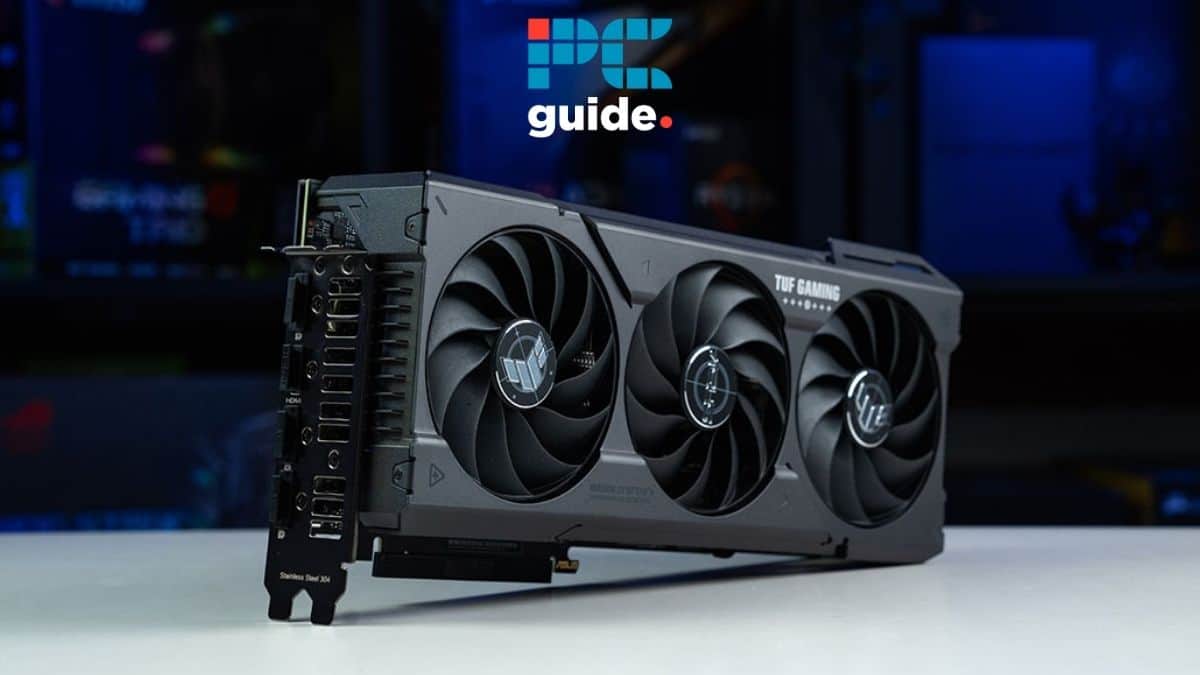
Best Graphics Card 2026 Top GPUs For Gaming AI Value 71 GK950 SL. AC SL1500 . Best Graphics Cards For Gaming 2026 Onix BD Best Graphics Card For Gaming And 600x315h .webp. Top 5 Best Graphics Cards In 2026 For 4K Gaming Performance NoobFeed Radeon Rx 9060 . Best Budget Graphics Cards To Buy In 2026 For 1080p And 1440p Gaming Rx 9060 Xt . Best RTX 2060 Graphics Card 2026 Our Top Picks PC Guide Best GPU For 1440p 144Hz


8 Best Graphics Cards For Gaming 2026 Tested Compared Featured Image Bqrbfc 2 . Best Of CES 2025 Performance And Tom S Hardware . What Is A Good Graphics Card For Graphic Design . 13 Best GPUs For Gaming 2026 Top Graphics Cards Ranked Banner 5. HOW TO BUY THE RIGHT GRAPHICS CARD 2025 GUIDE Technical Best Graphics Card

10 Best Graphics Cards For 1080p Gaming March 2026 Guide Best Graphics Cards GPUs Laptops 1024x559 . What Is A Good Graphics Card For Graphic Design . Latest Graphics Cards For Gaming In 2026 UK Budget 1440p 4K Ranked Best Latest Graphics Cards 2026 Uk 1200x800 . Best Graphics Card For Gaming And 3d Modeling . 8 Best Graphics Cards For I7 7700K January 2026 Complete Guide Best Graphics Cards For Call Of Duty


Next DBD Chapter Release Date Estima Gamers Unchained Best Graphics Card 2025 . Best Graphics Card For Gaming And 3d Modeling . The Best Graphics Cards For Gaming In 2026 Best GPUs Of 2025 1024x1024 . Budget Graphics Best Graphics Cards In 2025 The GPUs I Recommend For . Best Mobile Gpu For Gaming Gpu Tier List 2025 OVMN Best Graphics Card For Gaming
Best Graphics Card For Gaming And 3d Modeling Best Graphics Card . Best Graphics Cards For Gaming In 2026 For Every Budget Techwhiz Inc Best Graphics Cards For Gaming In 2026 Top Picks For Every Budget 932fa099 C715 48d7 Bd3e. What Is A Good Graphics Card For Graphic Design . Best GPUs For Gaming 2026 Top VGA Cards Ranked By Performance 6 Best GPUs For AI And Deep Learning In 2026.webp. The Best Budget Graphics Cards For PC Gaming Under 250 YouTube
Best Graphics Cards For Gaming In 2026 Expert Graphics Card Trio RTX 5070 TI PRODUCT 900 X 600 . Best Graphics Cards GPUs Brands For Nvidia 2026 Best Graphics Cards GPUs Brands . Best Graphics Cards For Gaming In 2026 Expert Copy Of Copy Of Copy Of Copy Of TV Sale Empire 5 . Best Graphics Cards For Gaming In 2026 Tom S Hardware . 2026 GPU Prices Going Up Best Graphics Card To Buy Now Best GPU